Ask a commercial drone program what records the FAA requires and you’ll usually get one of two answers. Some programs keep everything, in six places, and can’t find any of it quickly. Others keep almost nothing, on the theory that Part 107 doesn’t say much about records. The second group is half right. Part 107 requires very few records. But it requires you to produce the ones it does require, on request, and it sets short clocks when something goes wrong.
In security work, the test of a log was never whether it existed. It was whether you could hand it to someone who didn’t trust you and have it hold up. The FAA’s rules for small drones work the same way. This post goes through what the text actually says, what you have to be able to show, and how quickly.
What 14 CFR 107.7 actually says
The inspection rule is 14 CFR 107.7. It has three parts that matter for a program manager.
First, the remote pilot in command, the owner, or the person on the controls must have the remote pilot certificate and identification “in that person’s physical possession and readily accessible” while exercising the certificate’s privileges. They must present both on request to the FAA, an authorized representative of the NTSB, “any Federal, State, or local law enforcement officer,” or an authorized representative of the TSA.
Second, they must “make available, upon request, to the Administrator any document, record, or report required to be kept under the regulations of this chapter.” Note the scope. It isn’t limited to Part 107. Anything required under 14 CFR is in play, which matters if you also hold a waiver, an exemption or a Part 137 certificate.
Third, they must allow the FAA “to make any test or inspection of the small unmanned aircraft system,” the pilot, and any visual observer, to determine compliance.
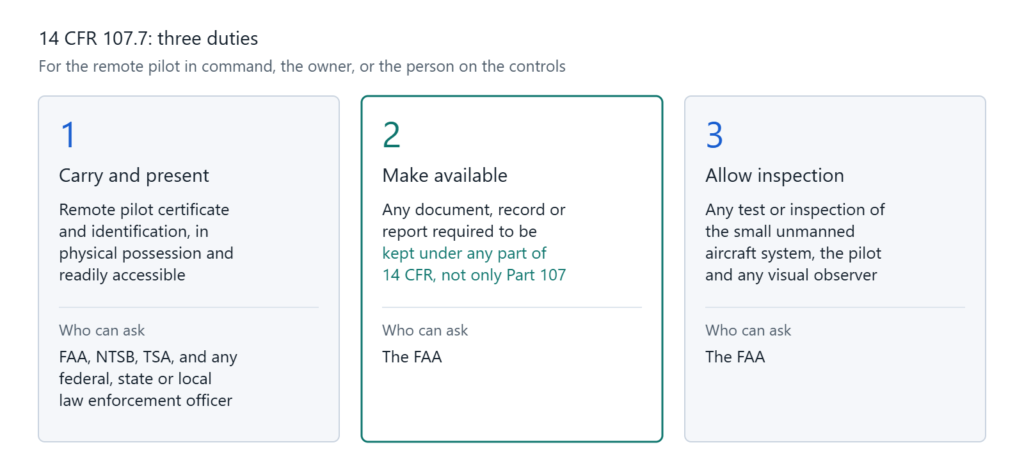
So the list of who can ask is longer than most people expect, and a local police officer at a job site is on it for the certificate. The list of what the FAA can ask for is defined by every other rule you operate under.
The short list of records Part 107 really requires
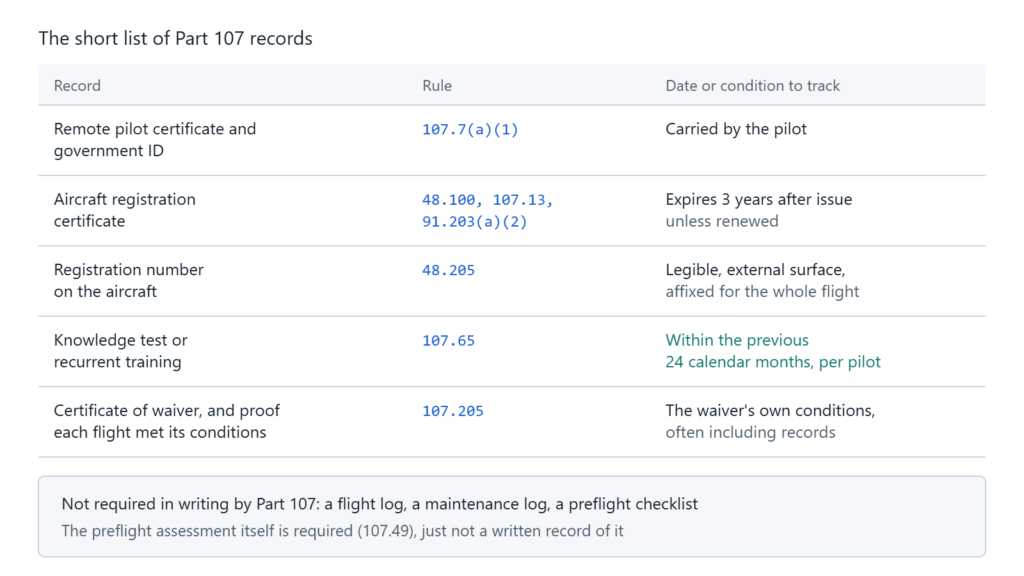
Here is what I’d expect any Part 107 operation to be able to produce on the spot or within a day.
- The remote pilot certificate and a government ID, carried by the pilot, per 107.7(a)(1).
- Aircraft registration. Small drones flown for anything other than limited recreational operations are registered under 14 CFR 48.100, and a Certificate of Aircraft Registration expires 3 years after issue unless renewed. Part 107.13 points to 14 CFR 91.203(a)(2), which requires an effective registration certificate for the aircraft.
- The registration number displayed on the aircraft. 14 CFR 48.205 requires it to be legible, affixed for the whole flight, and on an external surface.
- Aeronautical knowledge recency. Under 14 CFR 107.65, a remote pilot can’t exercise the certificate’s privileges unless they passed the initial test or completed recurrent training within the previous 24 calendar months. That’s a date per pilot, and someone should own it.
- Any certificate of waiver, and proof that each flight met its conditions. 14 CFR 107.205 lists what can be waived (night anti-collision lights, visual line of sight, operations over people and others). The waiver’s own conditions often carry recordkeeping terms. Those are records “required to be kept” for 107.7 purposes.
That’s most of it. Part 107 doesn’t require a flight log, a maintenance log or a preflight checklist in writing. 14 CFR 107.49 requires the preflight assessment itself, including weather, airspace, people and property on the surface, and control links, but not a written record of it.
My opinion, separate from the rule: if you’re ever asked to show that a preflight happened, “the rule didn’t require me to write it down” is a true statement that won’t help you much. Most aircraft already write a flight log. A short written preflight next to it costs a minute.
When something goes wrong: two clocks
There are two separate reporting regimes, and they ask for different things.
The FAA’s is 14 CFR 107.9. No later than 10 calendar days after an operation involving serious injury or any loss of consciousness, or damage to property other than the drone itself, the remote pilot in command must report it to the FAA. Property damage is exempt only if repair costs no more than $500, or the property’s fair market value doesn’t exceed $500 in the event of total loss. Ten days goes fast if nobody knows who is responsible for filing.
The NTSB’s is 49 CFR Part 830. Its definition of an unmanned aircraft accident covers any occurrence between activation for flight and deactivation in which a person suffers death or serious injury, or in which an aircraft holding an airworthiness certificate sustains substantial damage. Most Part 107 drones don’t hold an airworthiness certificate, so for most fleets the NTSB trigger is death or serious injury, while 107.9 still catches property damage over $500. Accidents and listed serious incidents require immediate notification to the NTSB “by the most expeditious means available.”
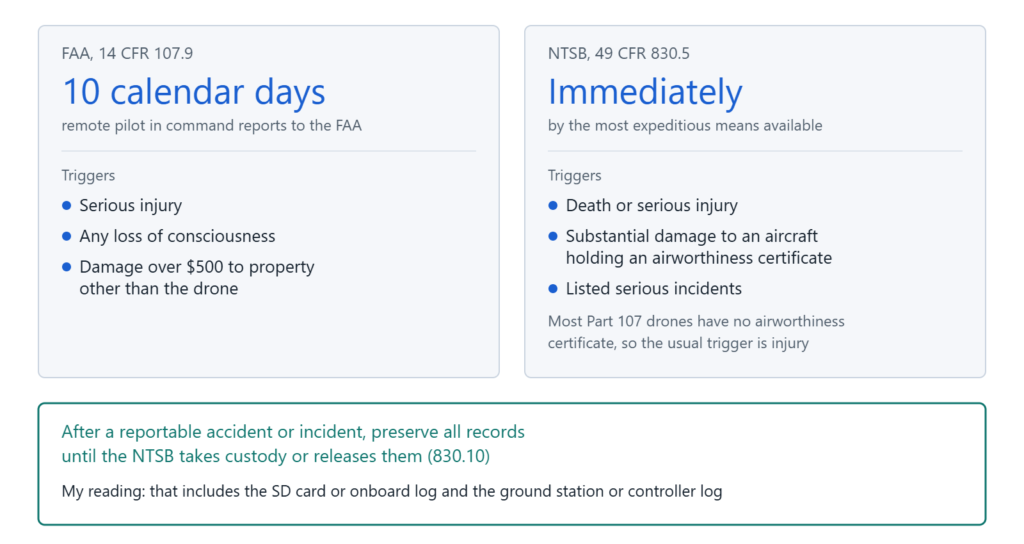
The NTSB rule is the one I’d underline for a records program. 49 CFR 830.10 makes the operator responsible for preserving “all records, including all recording mediums of flight, maintenance, and voice recorders,” related to the operation, the aircraft and the airmen, until the Board takes custody or releases them. For a drone, I read that as including the SD card or onboard log. The rule says “all records” pertaining to the operation, not just those on the aircraft, so I’d treat the ground station or controller log (a telemetry log on the laptop, or an app’s synced copy) the same way. The first instinct after a crash is often to pull the card, look at it, maybe reformat it and fly again. In a reportable accident, that card is something you’re required to preserve.
Why “on request” got more serious in 2026
The FAA’s enforcement posture toward drones changed this year, and it changes how fast a request can turn into a case.
According to the FAA’s Federal Register notice of April 17, 2026, the agency issued Compliance and Enforcement Bulletin No. 2026-1 on January 21, 2026. It requires legal enforcement action for drone operations that endanger the public, violate airspace restrictions, or further another crime. The notice says that after the bulletin, “most UAS violations are no longer eligible for compliance actions and must be handled with legal enforcement action.” Before it, the FAA often resolved careless cases with compliance actions when the operator was willing and able to comply.
The same notice set up the Drone Expedited and Targeted Enforcement Response program, DETER, effective April 17, 2026. Eligible first-time violators who are individuals can accept a significantly reduced civil penalty or suspension in exchange for resolving the case quickly. The FAA’s announcement says participants must admit liability and waive their right to appeal, and that the program is limited to less serious operational violations in select locations and timeframes. Violation Notices go out by FedEx and by email.
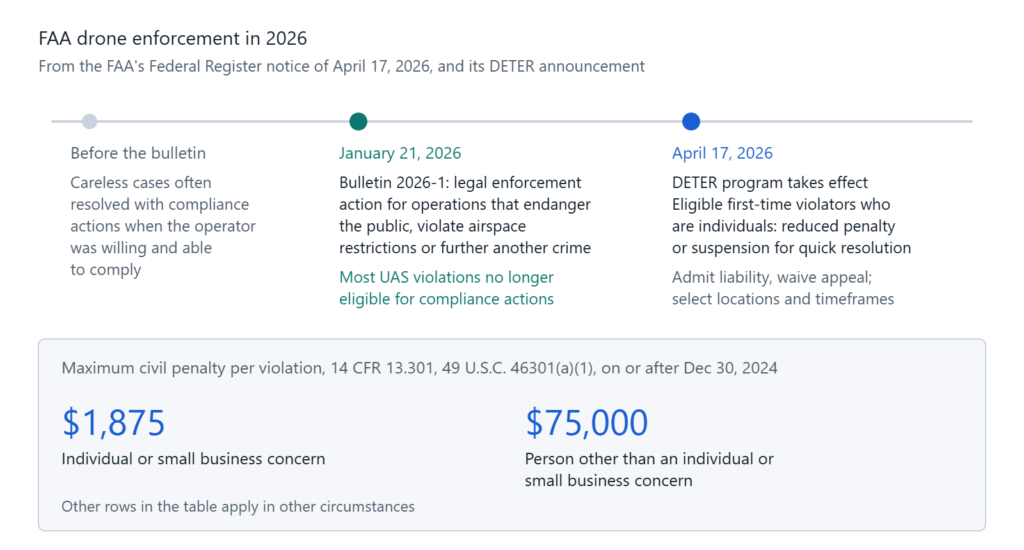
The ceiling matters too. The inflation-adjusted maximums in 14 CFR 13.301, for violations on or after December 30, 2024, are $1,875 per violation under 49 U.S.C. 46301(a)(1) for an individual or small business concern, and $75,000 for a person other than an individual or small business concern. Other rows in that table apply in other circumstances, so read it for your case.
One recent example shows how records and certificates stack up. In August 2026 the FAA proposed a $289,215 civil penalty against an agricultural operator in Washington state. The FAA alleges the operator used a drone on 15 occasions to dispense fertilizer without an agricultural aircraft operator certificate, and that the drone was not registered and did not have an airworthiness certificate. These are allegations in a proposed penalty, and the operator has the chance to respond. The relevant point here is that each alleged gap is a document someone could have been asked to produce. For Part 137 operators, 14 CFR 137.71 adds its own list: customer name and address, date of service, name and quantity of material dispensed for each operation, and pilot details, kept at least 12 months at the home base and available to the FAA on request.
A produce-on-request file
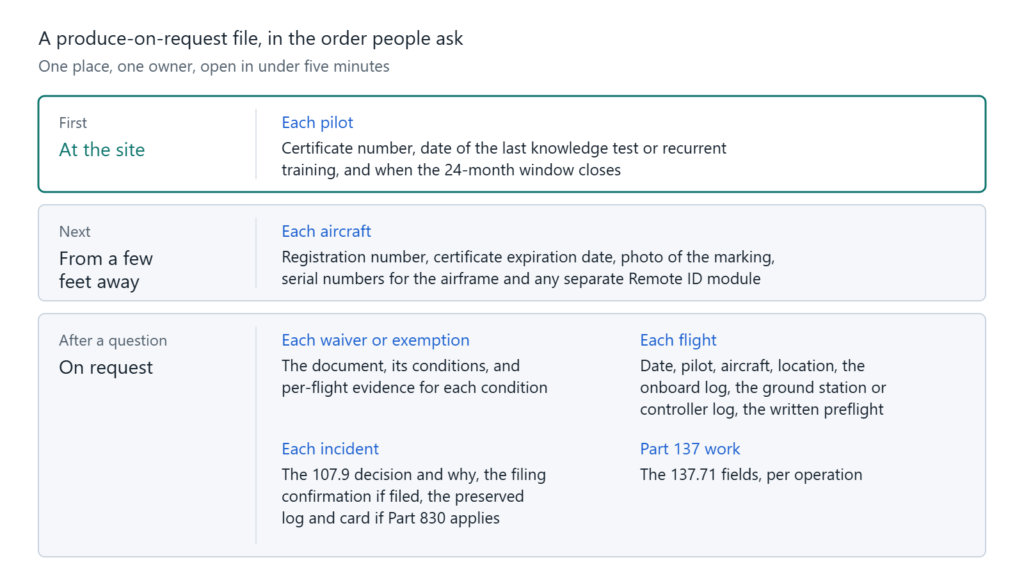
None of this needs software to get right. It needs one place, one owner and a habit. Here’s the file I’d want every program to be able to open in under five minutes:
- Each pilot: certificate number, the date of their last knowledge test or recurrent training, and when the 24-month window closes.
- Each aircraft: registration number, certificate expiration date, a photo of the marking, and serial numbers for the airframe and any separate Remote ID module.
- Each waiver or exemption: the document, its conditions, and per-flight evidence for each condition.
- Each flight: date, pilot, aircraft, location, the onboard log file and the ground station or controller log if one exists, and the written preflight.
- Each incident: the 107.9 decision (reportable or not, and why), the filing confirmation if filed, and the preserved log and card if Part 830 applies.
- For Part 137 work: the 137.71 fields, per operation.
The order of that list follows the order in which people tend to ask. The certificate comes first, at the site. Registration and marking come next, and they can be seen from a few feet away. Waiver conditions and flight records come when a question has already been asked.
The record has to exist before the question. Building it after a Violation Notice arrives is not the same thing, and anyone reviewing it will be able to tell.
This is a general explanation of the rules, not legal advice. For your operation, talk to an aviation attorney or your FSDO.